
Featured Style · May 20, 2026 · 6 min read
On the rule of three stones.
Why the simplest aquascape is the hardest to do well.
By Vincent Chan · Founder, Northwater Aquatics
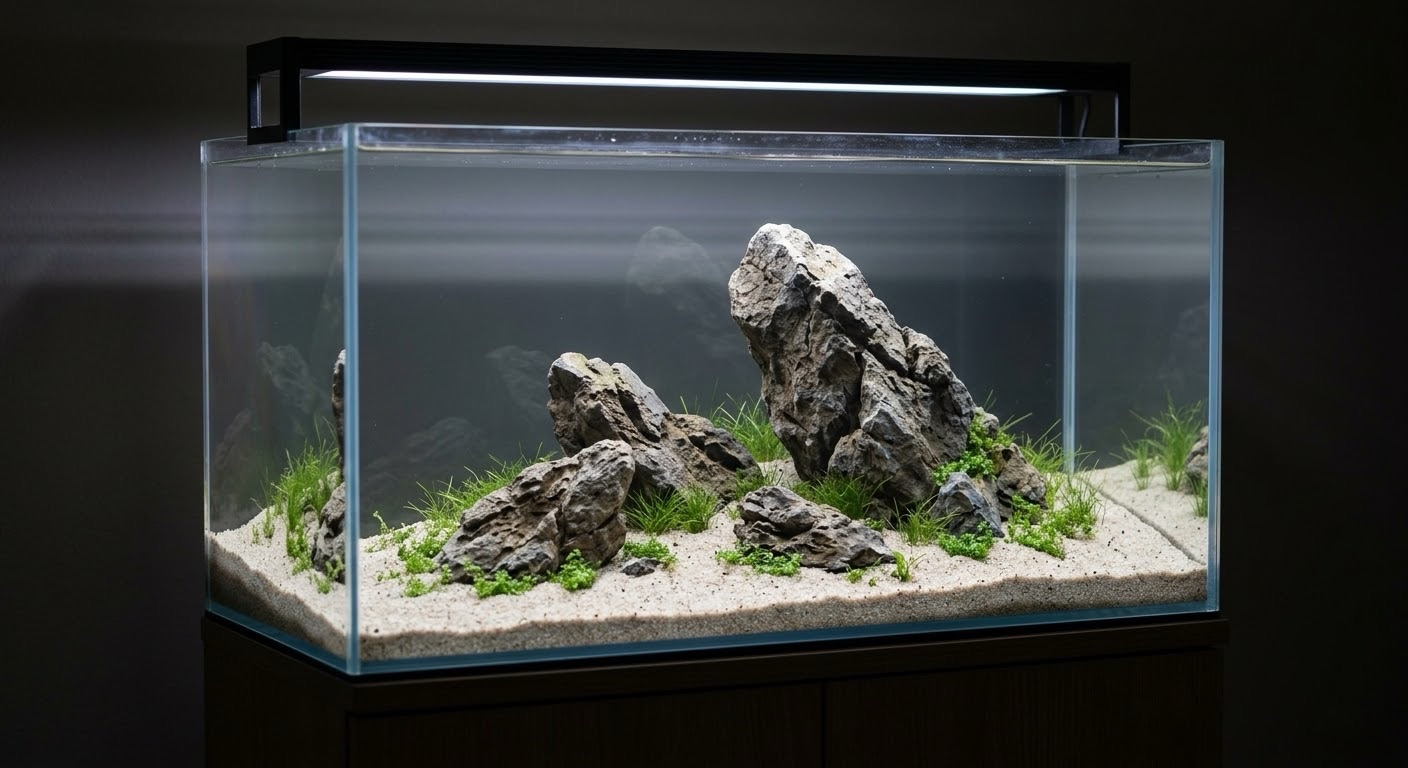
The first time most people see an Iwagumi aquascape, they assume someone just dropped a few rocks into a tank. The composition is sparse. The plants are minimal. The substrate is largely visible. There is, by the standards of most planted aquariums, very little going on.
That assumption is the whole trick. Iwagumi looks effortless. Done properly, it requires more discipline than any other school of aquascaping. The empty space is doing all the work.
What Iwagumi is, briefly
Iwagumi (literally 'rock formation') is the Japanese aquascaping tradition that descends from the country's garden design traditions. It is the most architectural school of planted aquariums, and the most photographed school after Nature Style. This essay is about something narrower than a full survey of the style: the compositional rule that makes the entire tradition possible.
The rule of three stones
At the center of every Iwagumi composition is a rule of asymmetric grouping. You use one main stone, called the oyaishi, and two to four smaller supporting stones. The total is always odd. Never two. Never four. Three, five, or seven.
The reason is the same reason photographers obey the rule of thirds: even numbers of subjects create symmetry, and symmetry calms the eye. Asymmetry holds the eye. An Iwagumi tank with two stones reads as a pair, balanced and quiet. An Iwagumi tank with three reads as a composition, in tension. You look at it longer.
Even numbers calm the eye. Odd numbers hold it.
Why three, not two
Three stones produce a triangle, the most stable shape in visual composition. The eye reads the triangle as a single subject, with one dominant element and two supporting ones. Two stones, by contrast, produce a line, which the eye reads as a comparison. The viewer's attention bounces between the two stones, looking for hierarchy, finding none.
Five stones extend the principle. They are read as two overlapping triangles, with the oyaishi shared between them. Seven extends further, but rarely beyond what a tank can hold without crowding the negative space, which is where Iwagumi does its work.
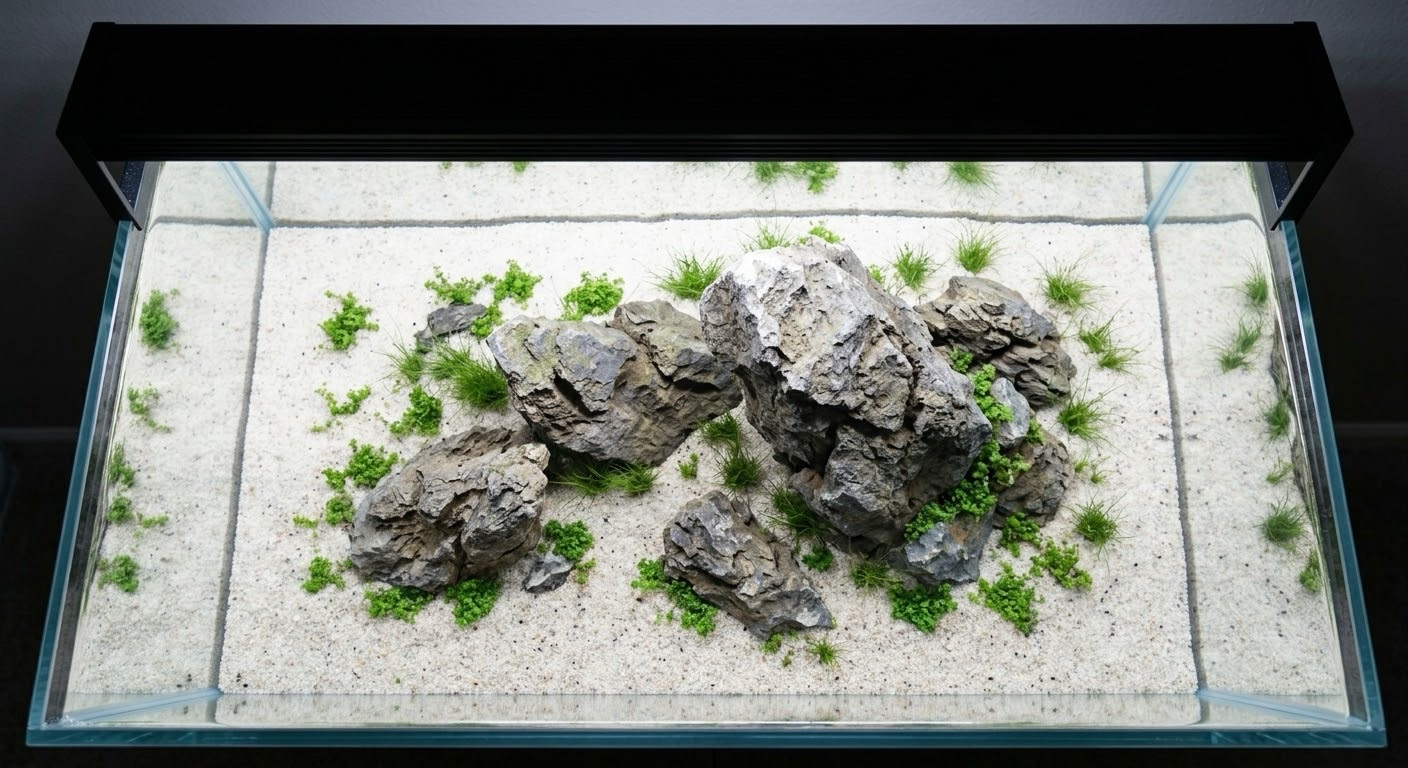
The composition, from above.
The stone hierarchy
Iwagumi assigns each stone a role. The vocabulary is Japanese and worth knowing, because the names describe relationships, not types.
Oyaishi. The main stone. The largest, the most visually arresting, and positioned along one of the rule-of-thirds intersections, never the center.
Fukuishi. The second-largest stone, placed near the oyaishi but tilted in a different direction. It reinforces without echoing.
Soeishi. A smaller supporting stone, often on the opposite side of the oyaishi, balancing the visual weight without matching it.
Suteishi. An even smaller throwaway stone whose role is only to soften the composition's edges. It is the stone that feels like an accident.
The names matter because they enforce hierarchy. Once a stone has a role, you stop being tempted to replace it with something larger.
Negative space as a material
What separates an Iwagumi tank from a tank with three stones is the treatment of everything else.
The substrate is exposed. The carpeting plant is kept low and even. There is no driftwood, no decoration, no second focal point. The water is empty above the stones. A school of small fish moves through but does not nest. The result is a composition where the eye is given room to settle on the stones and then drift through the negative space around them.
In every other aquascaping tradition, plants and hardscape compete for attention. In Iwagumi, the negative space is the material that holds the stones in place. Take it away and the tank turns into a rockery.
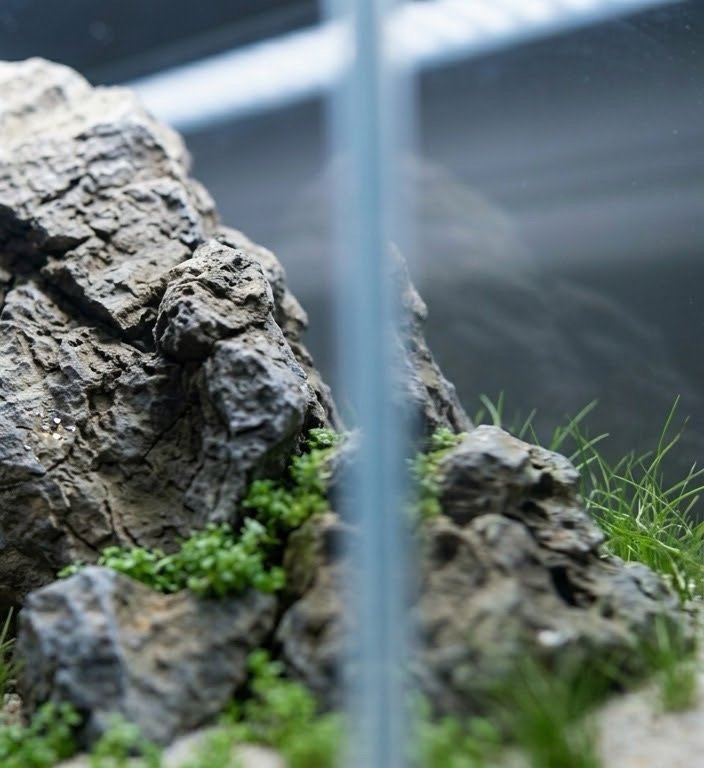
Negative space, treated as material.
The discipline of restraint
This is why Iwagumi is the hardest school to do well. The temptation, when staring at a sparse tank, is always to add. A piece of driftwood would look good there. A small group of stem plants would soften that corner. Another stone would balance the right side.
Every one of those additions is wrong. The whole point of Iwagumi is that the restraint is the design. The discipline is in what you do not place.
On simplicity
Iwagumi is not a beginner style because it is forgiving. It is, in fact, the school where mistakes are most visible, because there is nothing to hide them behind. A sloppy carpet, a stone placed slightly off the third, a fish that schools wrong: all of it shows.
But Iwagumi rewards the kind of patience the studio finds most worth cultivating. The aquarist who can hold three stones in a tank and resist the urge to add a fourth is the aquarist who will, in a year, have a tank worth photographing. The lesson, once internalized, applies to every other style.
A tank with one good stone, well placed, is more aquascape than a tank with twelve.
Vincent Chan · Northwater Aquatics
If this helped
Tell us what you're picturing.
We write back personally. Usually within forty-eight hours.