Featured Fish · May 20, 2026 · 6 min read
On Danio margaritatus.
The case for one species, told through a fish with two names.
By Vincent Chan · Founder, Northwater Aquatics
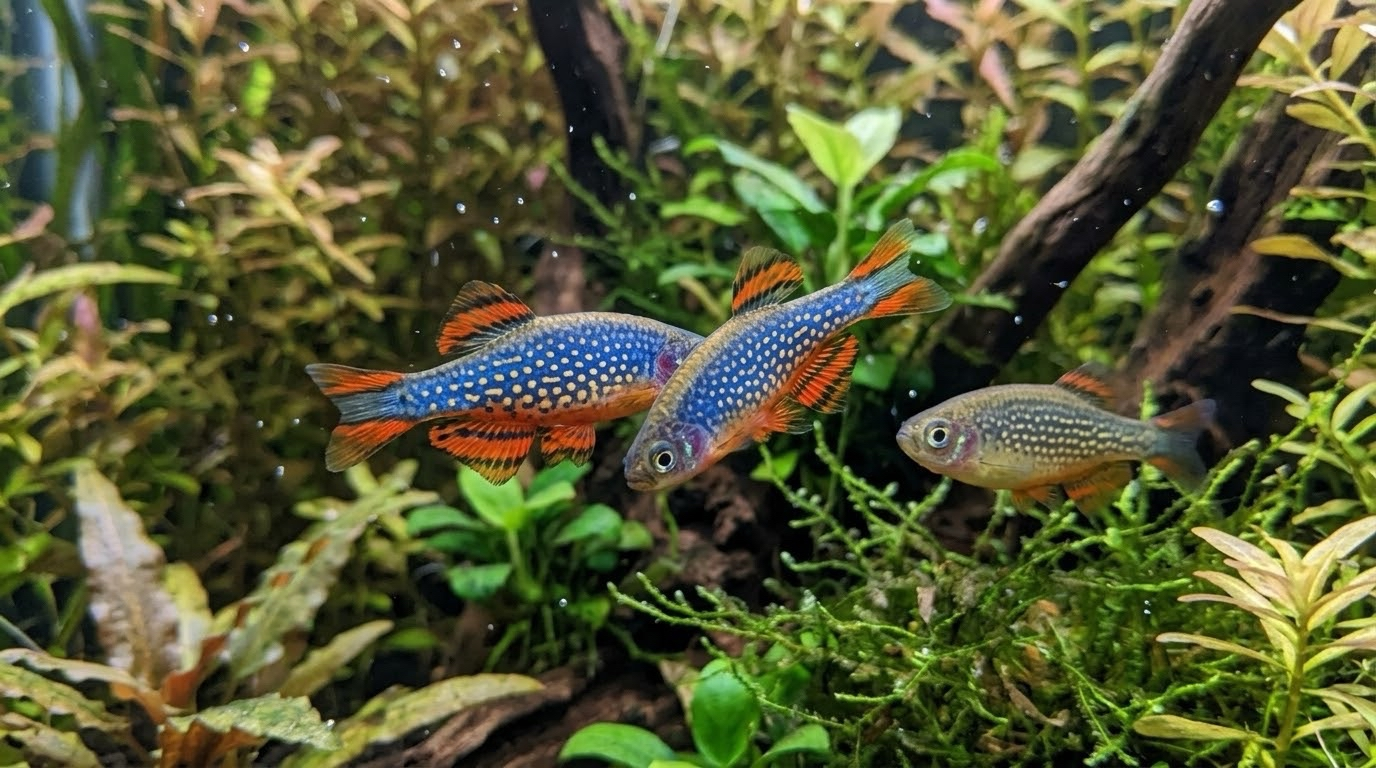
The first time most people see a galaxy rasbora, they assume the photo has been color-corrected. The fish is roughly two centimeters long, and its body is the color of a deep night sky, scattered with bright pearl-white spots that look painted on. Males carry red-orange fins. In a school of fifteen, moving through a planted tank, the effect is closer to bioluminescence than to ordinary fishkeeping.
The fish has two common names, both still in active use. One came first by accident.
Discovered, named, almost lost
In the summer of 2006, an aquarium exporter sent samples of a small, unusual fish from a pond near Hopong, in eastern Myanmar, to a few customers in Singapore. Within weeks the fish was being traded under the name galaxy rasbora, coined by hobbyists who had no scientific name to call it by. Demand was immediate and intense. The wild population at the source pond was thought to be exhausted within months. Reports from Myanmar in early 2007 described the original site as empty.
Then in mid-2007 the ichthyologist Tyson Roberts formally described the species. He placed it in a new genus, Celestichthys, and gave it the common name celestial pearl danio. Later DNA analysis moved it again, this time into Danio, the genus most aquarists already knew from the common zebra danio. The scientific name settled at Danio margaritatus. The trade name never caught up.
Other populations were eventually found in adjacent ponds, and the species is now captive-bred in volume and no longer threatened. But the early panic produced what is, in this hobby, a uniquely durable double-naming. Older shops and older hobbyists call it the galaxy rasbora. Newer shops and most field guides call it the celestial pearl danio. Both are correct. You will see one fish, twice, on every shop wall.
Why this fish, in particular
Setting aside which name you prefer, Danio margaritatus is a designer's fish. It is two centimeters long, which means a school of fifteen looks proportional in even the smallest planted tank. It needs cool, soft, slightly acidic water and a heavily planted environment, both of which suit the Iwagumi and Nature Style aquascapes the studio tends to design. It is peaceful, which means it can be the only fish in a tank without seeming sparse.
Most importantly, it is a shoaling species that only shows its full coloration in a group. A single galaxy rasbora is a beautiful but anxious fish, hiding in the substrate. Six is the minimum for it to feel safe. Ten begins to feel like a school. Fifteen is when the tank turns on, and the fish start treating each other as the environment rather than the threat.
Six is the minimum. Fifteen is when the tank turns on.
The case for one species
This is the part of the essay that started, in our notes, as a separate piece. The argument is simple. Most beginner aquariums are stocked the same way: three cardinal tetras, three neon tetras, three corydoras, a betta, a snail, a couple of shrimp. The intent is variety. The result is a tank where every group is too small to school, no fish has a confident presence, and the whole composition reads as visually busy and behaviorally muted.
The opposite move is what makes Danio margaritatus the studio's default fish for a first tank. Pick one shoaling species suited to your water and your tank size. Stock it in a group large enough that the fish stop watching for predators and start watching each other. Live with that decision for a year. Add a clean-up crew if you genuinely need one. Resist every urge to add variety.
The result is a tank that feels considered. The school becomes a single moving subject. The aquascape's negative space stays negative. The fish show colors and behaviors that mixed-community tanks rarely produce. Iwagumi and Nature Style aquascapes were both designed for this approach, which is part of why we recommend them so often.
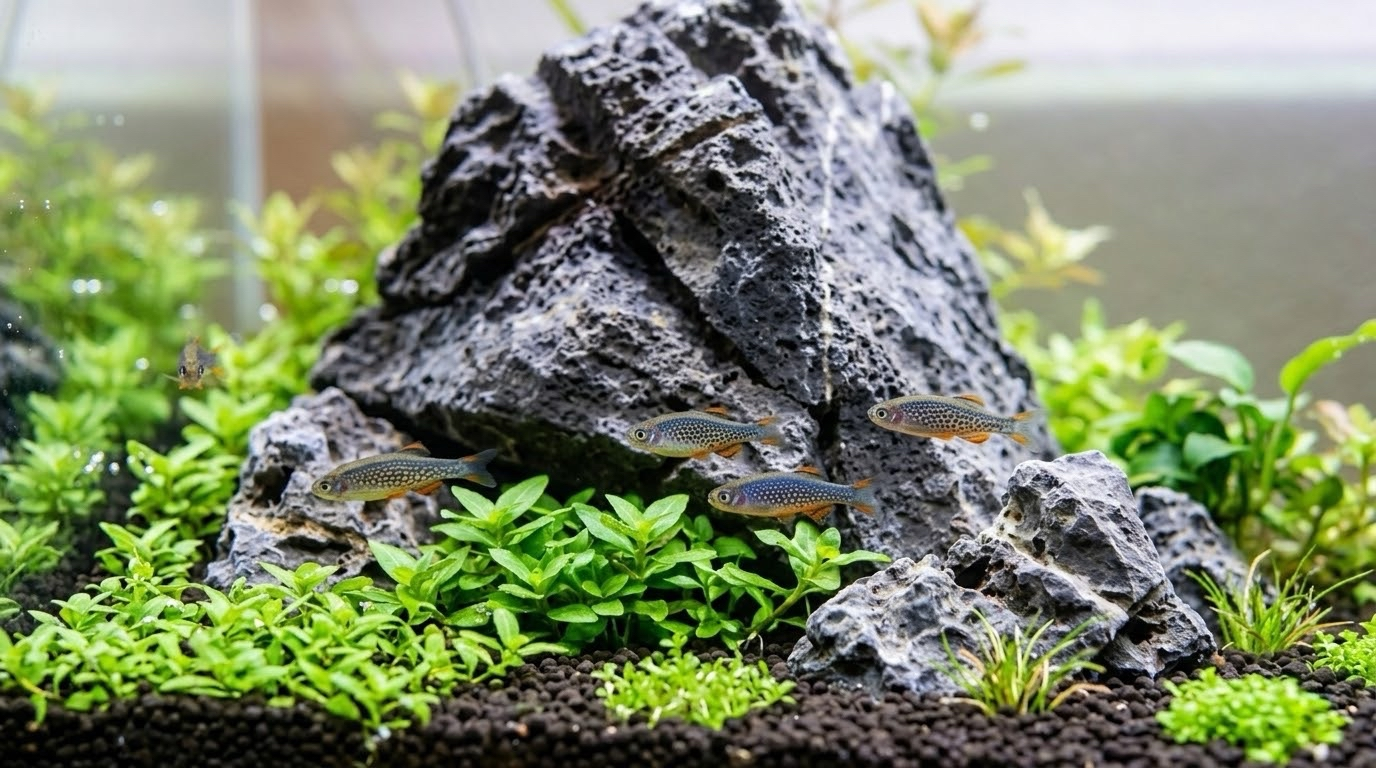
Considered, in numbers.
What we recommend
For a beginner planted tank in the ten to twenty-five gallon range, our default recommendation is a single school of fifteen to twenty Danio margaritatus alongside a small population of cherry shrimp or amano shrimp for clean-up. No second fish species. No betta. No neon tetras to add color, because the galaxy rasbora is already carrying the color.
For larger tanks, the same principle scales. A forty gallon tank with a single school of thirty rummynose tetras moving in tight formation is more striking than a forty gallon tank with seven species at five individuals each. The math, somehow, always comes out unfair in favor of the single school.
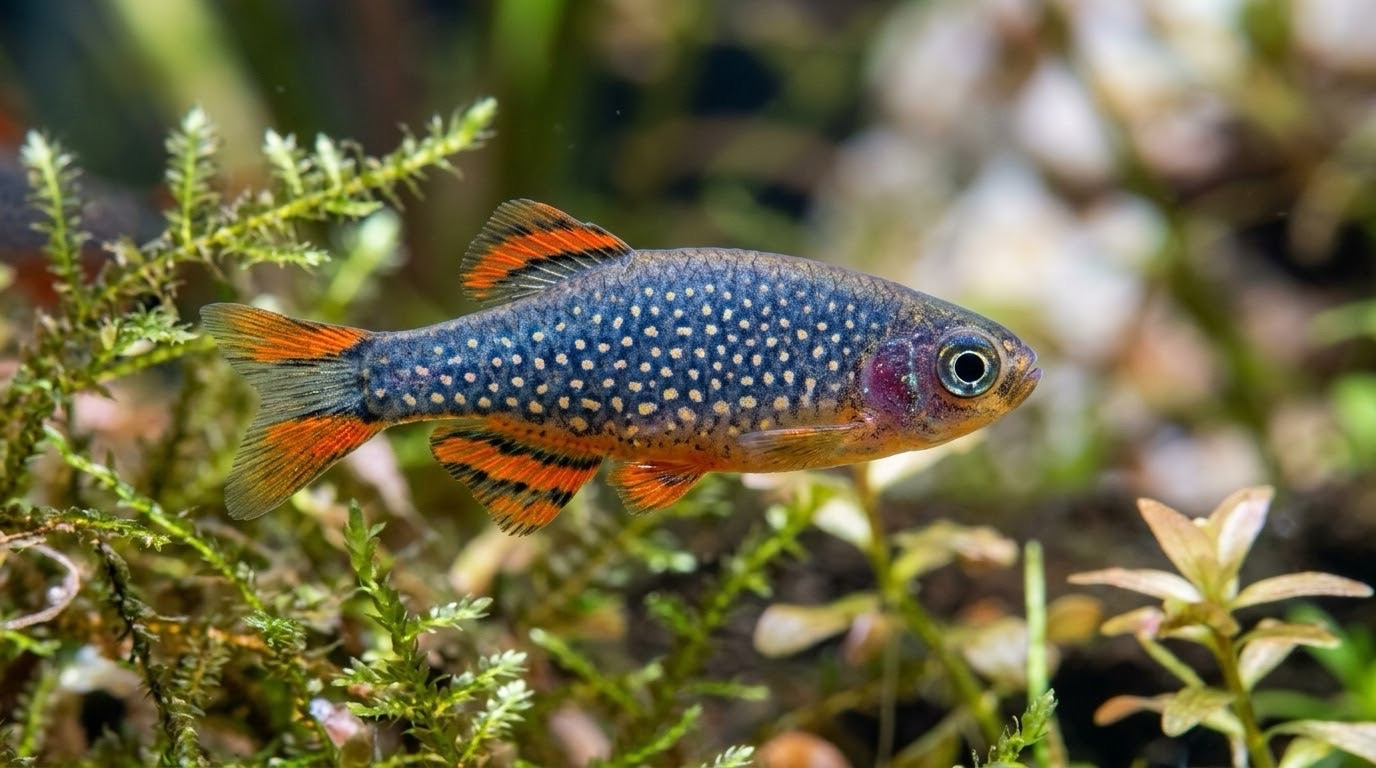
The source of the mark.
Why this fish is in our logo
The studio's mark is a stylized fish in the silhouette of a galaxy rasbora. It is not there for the reason most aquarium brands put a fish in their logo, which is recognizability. It is there because this fish, more than any other small species in the hobby, demonstrates the studio's central design instinct: that one well-chosen thing, in numbers, beats many half-chosen things.
The lesson applies to aquascapes. To rooms. To the decision to add another stone, or another plant, or another fish. It applies anywhere a tank's owner is tempted to fix something that does not yet need fixing.
A tank with one good species, well stocked, is more aquarium than a tank with five.
Vincent Chan · Northwater Aquatics
If this helped
Tell us what you're picturing.
We write back personally. Usually within forty-eight hours.