
Practice · May 20, 2026 · 5 min read
On the first thirty days.
What cycling actually looks like.
By Vincent Chan · Founder, Northwater Aquatics
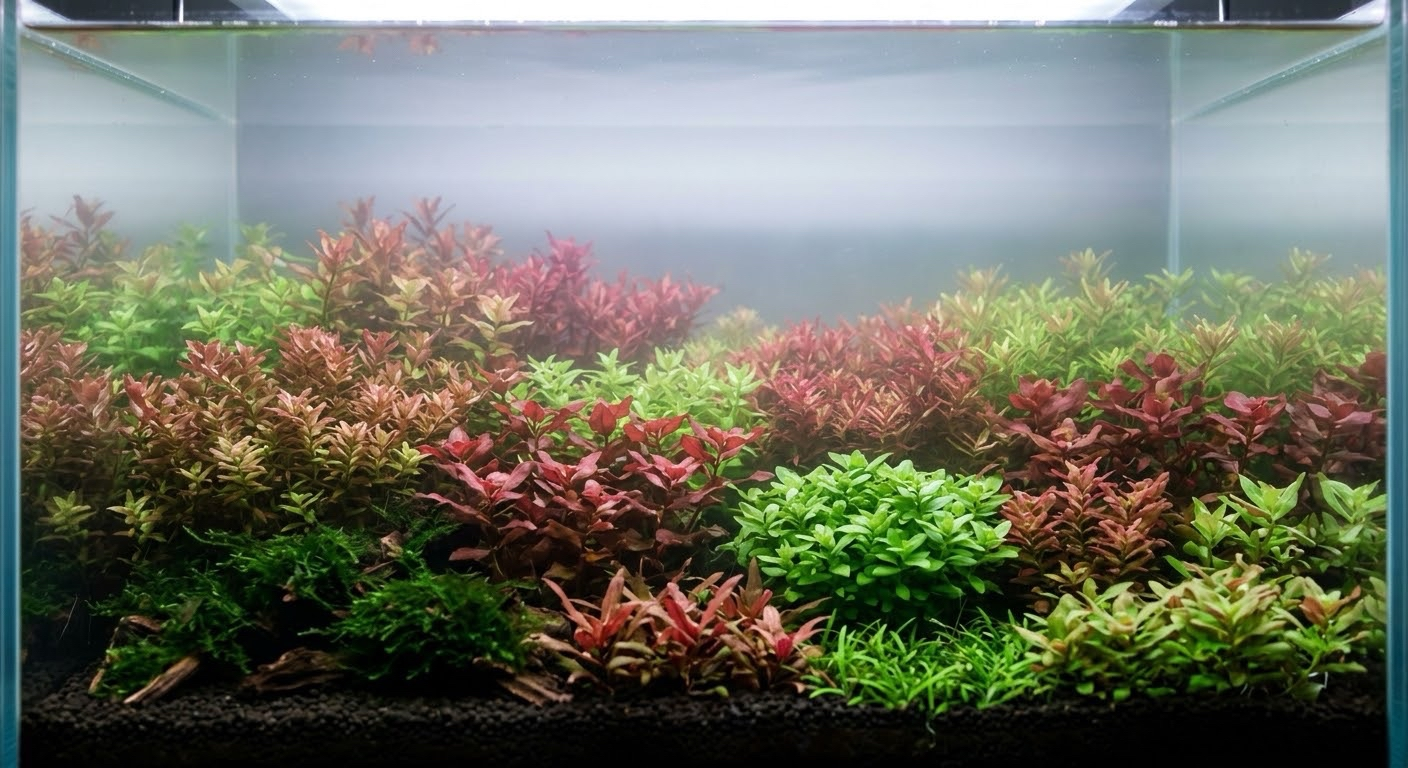
When people imagine a finished aquarium, they picture the photo. Clear water. Bright plants. Fish moving with purpose. What they rarely picture is the first thirty days, when the tank looks unfinished and the question that runs through every beginner's mind is some version of am I doing this wrong?
Almost everyone is doing it right. The tank is not unfinished. It is, in the most quiet and biological sense, becoming itself.
What cycling actually is
Every new tank goes through a process called cycling. Strip away the chemistry textbooks and it comes down to this: an aquarium needs a population of microscopic bacteria to live inside its filter, on its substrate, on its hardscape, and in the gaps of every leaf. These bacteria eat the toxic byproducts that fish and decaying plants produce, and turn them into something less toxic. Without them, even the most carefully chosen tank will turn against itself within days.
You cannot put the bacteria in. You can only feed them, wait, and let them grow.
That waiting is cycling. It usually takes between two and six weeks, depending on temperature, substrate, planting density, and how many fish you have asking the bacteria to work harder.
A timeline you can hold onto
Ammonia
Nitrite
Nitrate
Week one
The tank looks finished. It is not. Water might be slightly cloudy from substrate dust or from the first bloom of ordinary bacteria that haven't yet sorted themselves into the useful kind. Plants will sit there. A few will start sending out new growth. Most of what's happening you cannot see.
Week two
Ammonia rises. This is the toxic byproduct fish produce; if you have fish in already, it stresses them. If you don't, it's just feeding the bacteria you want. You'll see nothing on the surface, but if you test the water, the numbers move.
Week three
The first group of bacteria, the ones that eat ammonia, start outpacing the production of it. They turn ammonia into nitrite, which is also toxic. Now the second group of bacteria, which eats nitrite, begins to grow. The water often looks at its worst this week. Cloudy, slightly off-color, a touch tannic if there's wood.
Week four
Nitrites peak and then drop. The second group of bacteria catches up. Nitrites become nitrates, which are mild and removed by water changes and plants. You see the tank clear. Plants visibly grow. A new kind of stillness sets in.
Weeks five and six
The tank is cycled. The biology is in equilibrium. Stocking can begin in earnest, a few fish at a time. You stop checking the water every morning.
Three things that look like problems, but aren't
Looks like a problem
Cloudy water.
Week one or two cloudiness is almost always a bacterial bloom. Those microscopic bacteria are multiplying so fast the water turns hazy. It resolves on its own, often within forty-eight hours. The instinct to do something (water change, treatment, panic) is the wrong one. Wait.
Looks like a problem
Plant melt.
When you put a plant from an emersed nursery (grown above water) into a tank, the original leaves often die back. They look brown, slimy, alarming. Underneath, the plant is growing new leaves adapted to submerged life. Trim the melted leaves off. The plant is fine.
Looks like a problem
Fish hiding.
Most fish, in the first week or two of a new tank, will hide. The space is unfamiliar; the cycling biology is unstable; they are reading the room. Resist the urge to add more fish to make the tank feel populated. The right ones will emerge.
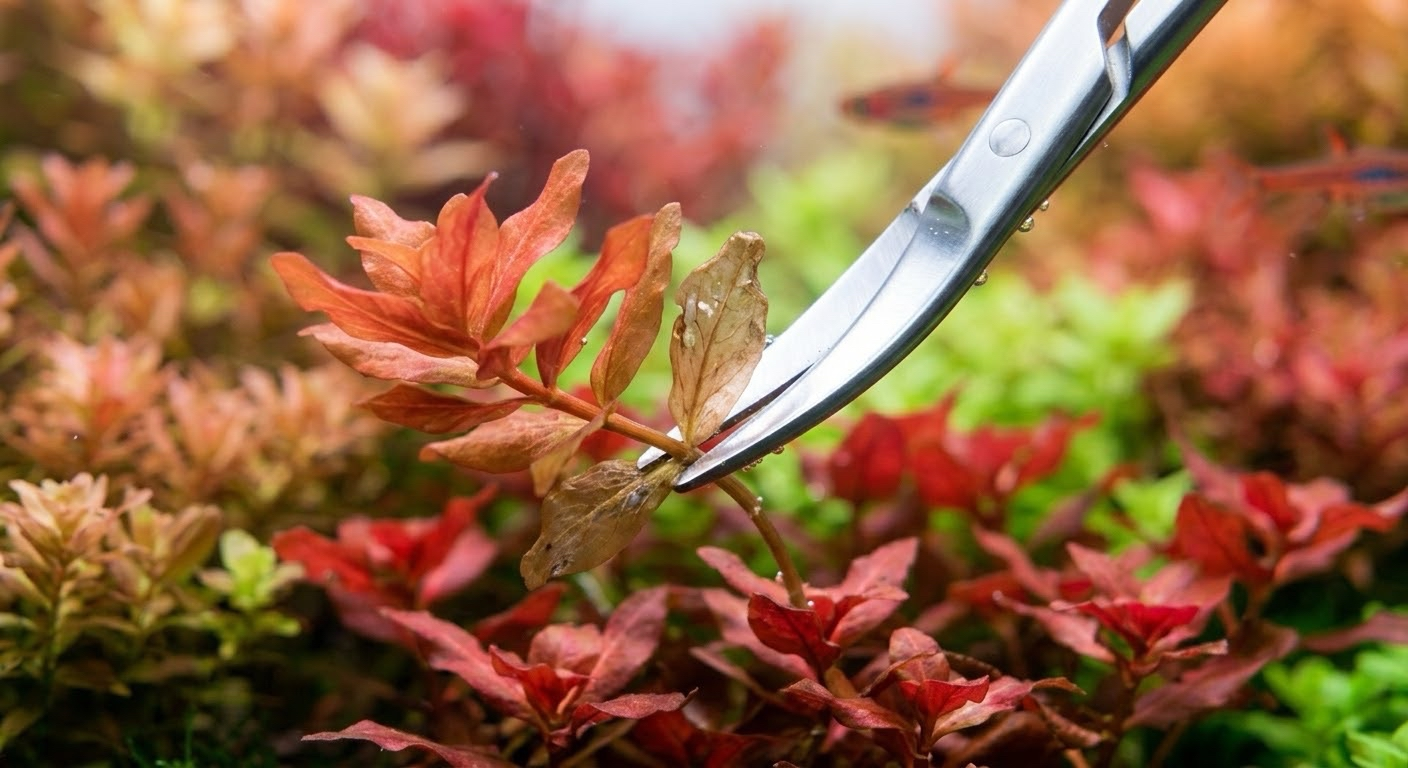
Plant melt, removed.
When to actually worry
Three real warning signs, in order of urgency: fish gasping at the surface (an oxygen or ammonia emergency), a sudden ammonia spike that doesn't drop after a water change (the cycle has crashed), or a fish covered in white spots or fuzzy patches (disease, not cycling). Each has a specific response. None of them are part of normal cycling.
Everything else is almost always normal, even if it doesn't feel that way.
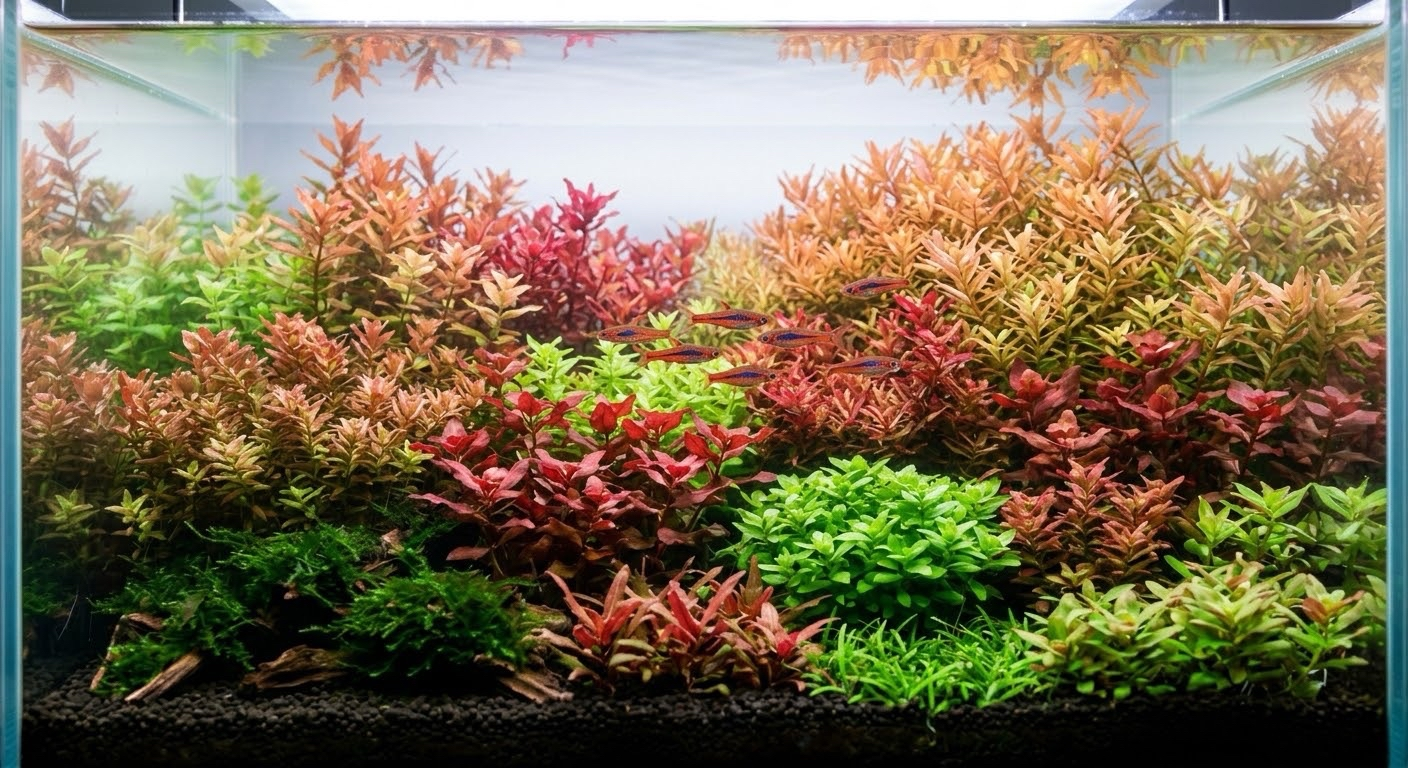
Week four, settled.
On patience
The first thirty days are the part of the hobby that filters out impatience. They are also, quietly, the part that defines who you become as an aquarist. The people who learn to wait through cloudy water, who let the tank settle into itself, who resist the urge to fix what isn't broken: those are the people who keep tanks for years.
This is the part where we earn our work. Not in the design, not in the install, but in the calm voice on the other end of an email at the moment a new tank's owner is sure they've ruined everything.
You haven't.
Vincent Chan · Northwater Aquatics
If this helped
Tell us what you're picturing.
We write back personally. Usually within forty-eight hours.